Note
Go to the end to download the full example code.
neta
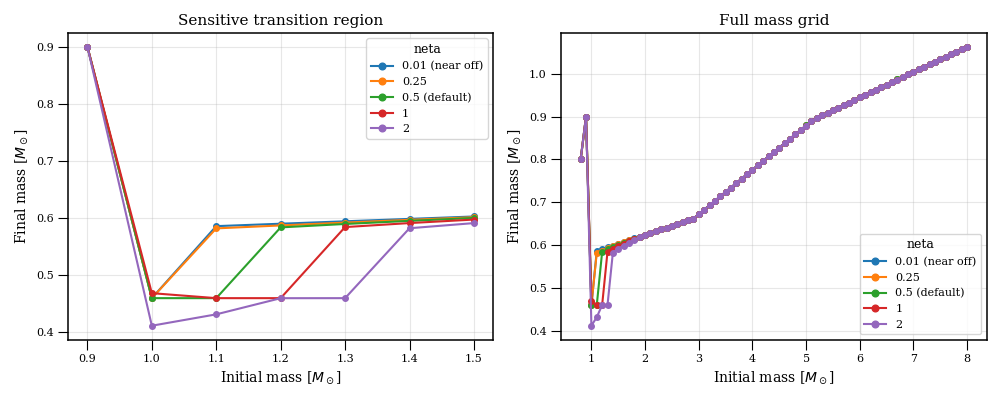
This example shows the effect of the neta setting on low- and
intermediate-mass single-star evolution. neta is the Reimers wind
coefficient, so it mainly affects cool evolved stars on the red giant branch
and asymptotic giant branch.
COSMIC requires positive neta values, so neta = 0.01 is used as a
nearly-off control. The left panel focuses on the narrow mass range where the
final mass is most sensitive to neta. The right panel shows the same final
mass comparison over the full initial-mass grid.
import sys

sys.path.append("..")
import generate_default_bsedict

import matplotlib.pyplot as plt
import numpy as np
import pandas as pd

from cosmic.evolve import Evolve
from cosmic.sample import InitialBinaryTable

BSEDict = generate_default_bsedict.get_default_BSE_settings(to_python=True)
plt.style.use("../_static/gallery.mplstyle")
plt.rcParams.update({
    "font.size": 9,
    "axes.titlesize": 11,
    "axes.labelsize": 10,
    "xtick.labelsize": 8,
    "ytick.labelsize": 8,
    "legend.fontsize": 8,
    "legend.title_fontsize": 8,
})


neta_values = [0.01, 0.25, 0.5, 1.0, 2.0]
masses = np.round(np.arange(0.8, 8.05, 0.1), 2)


def make_single_star_grid():
    """Build the low/intermediate-mass single-star grid."""
    n_systems = len(masses)
    return InitialBinaryTable.InitialBinaries(
        m1=masses,
        m2=np.zeros(n_systems),
        porb=np.ones(n_systems) * -1.0,
        ecc=np.zeros(n_systems),
        tphysf=np.ones(n_systems) * 13700.0,
        kstar1=np.ones(n_systems),
        kstar2=np.zeros(n_systems),
        metallicity=np.ones(n_systems) * 0.014,
    )


def neta_label(neta):
    """Format labels so the default and nearly-off cases are explicit."""
    if neta == 0.01:
        return "0.01 (near off)"
    if neta == 0.5:
        return "0.5 (default)"
    return f"{neta:g}"


def summarize_final_state(bcm, neta):
    """Collect final masses for one neta value."""
    final_bcm = bcm.sort_values(["bin_num", "tphys"]).groupby("bin_num").last()

    summary = pd.DataFrame(index=final_bcm.index)
    summary["neta"] = neta
    summary["initial_mass_1"] = masses[summary.index.astype(int)]
    summary["final_mass_1"] = final_bcm["mass_1"]
    summary["mass_lost_1"] = summary["initial_mass_1"] - summary["final_mass_1"]
    summary["final_kstar_1"] = final_bcm["kstar_1"]
    return summary.reset_index(drop=True)


def evolve_neta_grid(grid):
    """Run the single-star grid for each neta value."""
    summaries = []

    for neta in neta_values:
        settings = BSEDict.copy()
        settings["neta"] = neta
        settings["random_seed"] = 1

        bpp, bcm, initC, kick_info = Evolve.evolve(
            initialbinarytable=grid,
            BSEDict=settings,
            dtp=25,
        )
        summaries.append(summarize_final_state(bcm, neta))

    return pd.concat(summaries, ignore_index=True)


def plot_final_mass(ax, data, title):
    """Plot final mass as a function of initial mass for all neta values."""
    for neta in neta_values:
        subset = data[data["neta"].eq(neta)].sort_values("initial_mass_1")
        ax.plot(
            subset["initial_mass_1"],
            subset["final_mass_1"],
            marker="o",
            markersize=4,
            label=neta_label(neta),
        )

    ax.set_xlabel("Initial mass [$M_\\odot$]")
    ax.set_ylabel("Final mass [$M_\\odot$]")
    ax.set_title(title)
    ax.legend(title="neta", fontsize=8, title_fontsize=9, markerscale=1.2)
    ax.grid(True, alpha=0.3)


grid = make_single_star_grid()
summaries = evolve_neta_grid(grid)
zoom = summaries[
    (summaries["initial_mass_1"] >= 0.9)
    & (summaries["initial_mass_1"] <= 1.5)
]

fig, axes = plt.subplots(1, 2, figsize=(10, 4.0))

plot_final_mass(
    axes[0],
    zoom,
    "Sensitive transition region",
)
plot_final_mass(
    axes[1],
    summaries,
    "Full mass grid",
)

plt.tight_layout()
plt.savefig("neta_flagtest.png", dpi=150)
plt.show()
Total running time of the script: (0 minutes 3.728 seconds)